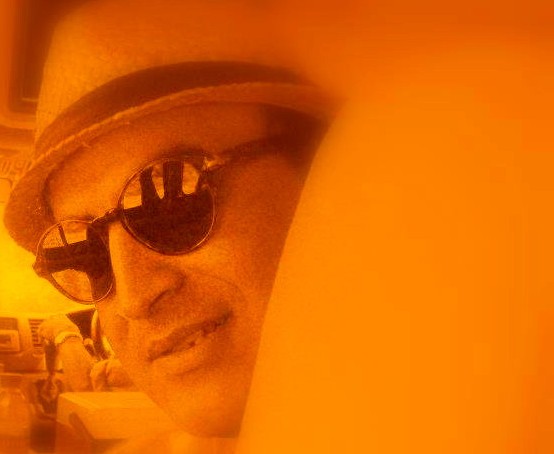
Eyebrows

Eyebrows are counterfactual. Like shoes, you don’t notice eyebrows unless they are particularly right or tragically wrong. As someone who has spent many years in an intense relationship with his own intentional brows, I’ve come to realize that they are not trivial. Eyebrows matter. In a sense, eyebrows serve the face’s highest function — that of communication, intention, and more importantly seduction. Eyebrows show interest, engagement and understanding. Raising, furrowing or shifting them ever so slightly registers and interchanges attention.

Incidentally (or not), all of those attributes are important elements of expressive personalities. Expressive people are context-lover, storyteller, competitive, and exaggerator. Expressive personalities consider emotions as well as the facts. For them, respect stands higher than fairness, spirited is better than considerate, popular sits on higher ground than peaceful. Expressive people have an active role in conversations. They just don’t sit on the side and take notes. They can’t bear misunderstanding.

Expressions have some downsides. Expression inherently contests impassivity. Any measured behavior that requires absence of emotions contrasts expression. If you’re expressive, you can’t hide feelings and you’re in need of telling your story. That will eventually come back to haunt you. These days, such incongruities are all too common. Frequently, I blame my expressiveness on my eyebrows. But great eyebrows are not easy to come by, because you can’t have great eyebrows by just leaving them alone.

Cupcake

I only lived with my parents for twelve years. For variety of self inflicted reasons I was shipped off at early age to live with my maternal and paternal grandparents, and then I immigrated after that. I’ve always considered that historical context to be one of the main reasons as to why I have a tendency to fortify what my parents might have imagined for me. Often times, when my parents want me to do something specific with my personal life, I only do the part I can do from my computer.

I met Irna back in 1998. She was my coworker. She was very straightforward. After a couple of months we ended up going out on a date. At the end of the dinner on the first date, she let me know that she wanted to get married. She shared that wish while she was having a cupcake at the end of the dinner. Though she seemed very smart and beautiful, I remember my initial and implicit reaction featured reluctance, mainly because I didn’t like the way she ate the cupcake. That’s how we made decisions back in Canada.

A couple of years passed and all of our friends got married. We went to countless weddings together and played flawless we-are-a-beautiful-couple. But make no mistake the pressure was on and so I sheepishly decided to initiate an appropriate conversation to gauge her interest. Only, to find out that she needed to consult with her mother. The next day, her mother showed up at my work and seemed like a person who had been kicked by a drunken horse. She then offered to take me out to lunch. During lunch she opened up the conversation and set out an impossible set of requirements. For some odd reason, she kept finishing each requirement by saying “if you’re interested in Irna”, which I found to be probing. I quietly listened to what she had to say. My only defense mechanism was a smartass stare from the corner of my eyes while my head formed a 45-degree angle towards her. In an awkward moment of silence, she seemed as if she was waiting for me to say something, but I just called the waitress and ordered a cupcake.

Parents raise their children to make them a part of the future. Parents know so well they won’t be alive to see a big part of that future. The irony with first generation immigrants hides beneath the fact that they’ve chosen to leave their past in hope of a better future, but sadly when it comes to their children, they force back that abandoned past into the wishful future of their children.

Parents are amongst the most important people in our lives. But that doesn’t warrant a blindfolded relationship where they tell, and we get told. There should be room for reasonable discourse and pragmatic give and take. If I had listened to my parents when I was younger, I could have never been able to do this part on my computer. More importantly, there would be no opportunity to discuss relationship issues while having cupcakes.

Mr. Mrtinello

[Story] – In university, I took an optional course called The History and Philosophy of Science. The professor who passionately taught the course was Mr. Martinello. He was a middle-aged man who looked like a used up guy and a certified mad scientist. One day and as he was discussing Einstein’s marital problems, he ended his sentences by saying “…Einstein might have been the most gifted scientist the world has ever seen, but paying attention to others is the rarest and purest form of generosity, and it seems he lacked it”.

Losing Weight

Today and during an after-work gathering, someone asked me “do you have a partner?” … This question, at its core, is very much San Francisco style of information inquiry. But guess what? That’s not the most interesting part of the story.

I responded by saying, “Oh, my personal life is a disaster zone”. I don’t know why I said that in a work setting, but I immediately felt like I’ve never been that honest about a topic that involves my privacy and me. I also answered the question, without answering the suggestion that was implanted in the question.

That said, I think I should stop losing weight.

Diapers

One of my close friends once asserted, “We are all very interesting and adorable at the beginning, and at the end of our lives. It’s just during the times in the middle when we could be odd, confused, and tedious.”

So simple. Yet so true. The statement made me think about that curious middle phase that starts around twenties and ends around early sixties. Ironically, during that middle phase we don’t need diapers either.

The red thread that connects that path is curiosity. It is the transitional characteristic of that phase between hope and contentment. Stay curious, my friends…

Dawn

Back in October of 2002, my coworker Dawn called me to her office. I knew something was wrong, and I knew I was about to be preached about something. It was one of those gloomy and cold Seattle days too, and by the measure of one’s mood, that was the last thing I needed on that very day.

After a few trivial blabs, she switched to the heart of the matter. She said “a couple of coworkers think you’re too rigorous for your own good and they feel that they’re pushed by you”. After a long and awkward moment of silence, I began explaining the “why” and the “intentions”. She listened very carefully and she continued by saying, “I hear you, and I agree with you. But this is not about reasons, it’s about their feelings”…

Human interactions are super complex, especially when your audience is smart enough to find ways to make their feelings sound reasonable. They argue with you within the frame of reason and facts, but their very argument is initially fueled by emotions. In such circumstances, you find yourself going about discussing and arguing for hours with no hope for convergence. His or her representation doesn’t clearly seem emotional, and sadly, your explanation doesn’t address the matter it needs to -until someone volunteers to stop the reticence.

The other complicated part relies on the egocentric approach one might choose. The attitude of “why do I need to change anything?”. Well, we as human beings are social animals, and in stark need of approval by others. Either accept this principle, or face the never-ending cycle of seasonal friendships and relationships that got shaped over a drink in cocktail parties. It is not important what you did or said or what the intention was. Within the realm of social norms and etiquette, it is utterly important how your actions were received.

Independent individuals spin around themselves and end up at the center of their own existence. That is an option. It is an electrifying option. It creates blasting energy around one, and others get attracted to that electricity for the duration of the lightening. The other approach, however, could be seeing the energy through for a long time.

As I’m getting older, I feel the responsibility of protecting my friendships and relationships more and more. It comes around as an impossible task at times, but that doesn’t warrant lack of trying. The attempt may not portray you as a solid or confident person. You need to show your cards, and tear down the wall in front of you. You need to make the approach to discuss the misunderstanding(s), which will inherently make you seem like the one in need. It takes a lot out of you and puts you out there, but you have to do it if you ever believed in consequence and humility.

…I listened to Dawn on that gloomy day. I went back to my coworkers and we discussed the issue over lunch. They were more than gracious to let go. They also understood that I had no intentions to be pushy, but that was not primarily the question. The issue was, they had felt what they had felt.

Somebodies

I’m going to start a theme of articles called Somebodies – , that tell short stories about everyday people. The kind of people who may seem invisible. They go about their lives as if they’re sons and daughters of nobody, but they are somebody.

This theme includes six women and two men. At first, nothing stands out as an interesting characteristic about these people. But they have all experienced defeat, and touched the depth of life in their own way, and then found their way back to zero. For them, the high point of life is the ground level. So life doesn’t offend them, anymore.

Expect vagueness, and cryptic-like story telling. Don’t look for details that usually help us in making logical connection between data points. They’re doing their best to tell, but not tell.

To be continued…

Fiona

People, places, things, and I’m continuing to find people the most interesting of all, maybe because we’re all beautifully imperfect creatures. People are interesting mainly because of the untold stories. Everyone homes great stories that are different than others’.

Through a series of events, I came to know Fiona. Her intelligence portrays itself in form of her acquaintance to scientific mysteries, silence, and humor. She is selectively kind and exudes perfection, but you know there are untold stories around the innate waves and flares. She gives the impression that she is daughter of nobody, but there are maternal instincts and clues in her words and traits. She reflects sturdiness, and an enticing version of vulnerability –both at the same time.

I die to know about her untold stories, but they have to come on their own rhythm and tune to stay pure and personal…

Altitude Matters

Like many, I had the opportunity to waste 6+ years of my life in a couple of universities. As always the schools of medicine, engineering, and law were the ones that had long queues of enthusiasts. I picked Physics for undergraduate as my first choice because back then I believed “science rules man!”. How naïve.

Physics was an honest and clean pain in the ass as a faculty. No course was like the other. The epitome seemed all over the place in that it touched chemistry, electrical engineering, solid state, astronomy, statistics, and religion. It was only during the first year that I enjoyed some fun stories such as: apple fell from the tree while Newton was observing and flirting with the girls, -or- the twin paradox tale where someone tried to part the age of twin brothers by years, only if one of them could travel close to the speed of light. After the first year however, it all became mathematics of most intense kind –where we almost ran out of symbolic characters and had to tap into Greek characters to explain why space bends around mass.

Every learning was theory bound. Though that applies to all areas of science, Physics is highly theory dependent. Every theory starts and end with something like this: one day Adam was doing something and suddenly realized:

– A ~ B : A increases or decreases proportionally with B – Observation / Theory
– A : B : Let’s do some experimentation to find a curve as to what that proportion is – Experimentation
– A / B : All experimentations suggest there is a constant (=K) that relates A to B – Thesis
– A = K * B : and K came from experimentation. – Conclusion

And suddenly we have a constant and a law. The constant is called Adam’s Number. And ladies and gentlemen, here I give you the Law of Adam. Almost all of Newton and Thermodynamic laws were formed like this. The only complexities had to do with the context and environment where K could be a function of temperature, time, or dimension.

This is how physics legitimized itself. Physics went to bed with Mathematics, to look secure and complete. I know my description seems funny and simplistic. Doesn’t it? Read on…

During graduate studies and in order to get accredited I had to take two other courses: Philosophy of Science and History of Science. That was a treat. Simply put, these two courses felt like some stood right in front of you and said “You think you learned some serious shit? Go Fuck Yourself”.

After six years of hard work and studying some of the most complex and abstract areas of science that had no resonation or correspondence to the outside world or everyday life, it was argued that : you should take everything you learned relatively and consider that some of the laws have been contextual and have lacked objectivity of criterion. Therefore they don’t pass coherentism and have problem of the criterion.

The punch line of the course was even more piercing. It inferred, Altitude of Perspective matters. The simple example was: the earth seems flat when you’re close to it. It’s round when you elevate. So we have two sets of laws that equally apply within context. Newtonian laws of gravity and General Relativity, respectively. After that course and the sudden collapse of my scientific beliefs, I have stopped placing all of my hopes on science. We all thrive to blend our beliefs in science in the hope that the overwhelming certainty and inevitability of science will prove our points. It’d take one years of logical and emotional exhaustion to realize how over-rated and relative that hope is.

Science is one of the best vehicles we possess to explain scoped problems, but science is not the only vehicle. Instincts, philosophy, and synaptic elasticity provide an invaluable sea of data. Human beings fall short of enjoying the ability to articulate or reason within that realm.

The Smart Alpha Male

Right in the middle of a pretty respectful gathering, he started speaking loudly and obnoxiously saying a lot of nothing. He was not communicating. He was positioning himself as the alpha male. His voice started to go a few octaves above two-lined and people around him were turning their head as if they were irritated. It all started becoming a scene after a few cold minutes.

Kim noticed the situation and walked across the room to get closer to the alpha male tribunal. The straight-shooter that she is, I thought she was going to ask for calm and quiet given someone else was giving a short speech. But to my disbelief Kim engaged in the banter and started laughing orgasmically -to attract the alpha male. From there on, I knew we had a show that would end up in my blog somehow.

A couple of hours passed and later on in the evening, Kim approached me for a chat and in the middle of our schmooze, she started asserting that the alpha-male-lookalike seems to be a smart bloke. I hope it’s not mean to say this: but for the first time in our long friendship Kim transiently looked like a goat to me –in that very quick moment. I suppose I was being very briefly judgmental. I just failed to understand why. I know I was hypercritical of Kim inherently and involuntarily.

A few days later, I was still feeling pretty crappy about having that instinct about a friend. I started asking myself questions like: was I judgmental? Is it fair that I didn’t say anything to Kim? Did I feel that way because Kim started participating in a socially unacceptable behavior? Do I like Kim, so I was being jealous when she complimented the alpha-male-lookalike? Should I talk to her about it? Am I a good friend if I don’t talk to her? Was I envious of the alpha male because he got attention? and the questions kept going, going, and going. Nothing seemed to connect however…

…and in an unassuming morning at a cliché moment it all came to me. I realized I had felt that way about Kim because she characterized the alpha male as smart. But why would that lead to such decree? How do I know if he is or isn’t smart. What does it mean to be smart anyway? Is being-smart equal to sounding-smart? After a lot of thinking, this is how I broke it down for myself: people usually and mostly inaccurately associate one or more of the following traits to smart:

– Quick get-it factor
– Articulation of facts, stories, and points
– Asking too many questions
– High education or multiple academic degrees
– Being master of a few skills such as music, sports, chess, games, etc.
– Being able to connect a few seemingly unrelated data-points (=intelligence)
– Patient analysis of issues
– Social manipulation
– Remembering names, phone numbers, etc.
– Having broad set of information about different topics
– Knowing historical facts
– Talking too much, as a mean of knowing too much
– Etc.

I’m afraid none of the above has to do with being smart by itself. The adjective (smart) is used to qualify the way one’s brain works. It has to do with the process of a) absorbing b) processing and c) communicating information. A smart person should have a unique ability in all of the three. The only attribute that can distinguish one person from another is (b), and sadly, that’s not immediately apparent because (b) is a function of time and well-formed unconscious.

First, curiosity holds the main weight in our ability for absorbing information as a multi-faceted faculty. The dearest tradition that’s also a painful and common non-sense remains to be the assumption that academic education is the best (and perhaps only) source of absorbing information. That’s why the myth of educated=smart surfaces all over the place. Let’s face it: there are only two reasons as to why one might think that way: the structured manner of academic education and accredited nature of academia itself. In my view, continuous reading and listening can be the most important sources of absorbing and refreshing information. Academia doesn’t necessarily or fully insure continuity and freshness of information.

Second, the most fascinating step happens during processing information. If there is anything as a God-given talent and/or genetic advantage hides under this rug. From neuroscience we’ve now learned that a synapse is the event which causes exchange (or production) of data between brain cells. I have this mental model of relating data to processed information. That means when two or more information points connect, data gets generated. Thorough research has verified the number of synapses per second differs from person to person, leading to the notion that there are people whose brains creates more data per second. I admit, I’m not one of them. My brain seems to have an inability to create data out of raw information without context. For instance, there was this professor in my college who would walk into a class and his default action was to write a painfully complex formula on the whiteboard. There were many of my classmates who seemed to immediately grasp it. I never did. Sometimes it took me the entire semester to understand the formula because I’ve always been handicapped by the story. I need to know the context, the problem, the why, and if that’s not enough, I would also need to attach value to the problem to actually direct some of my synaptic elasticity to the issue. By value, I mean I need to see if this is a subject I care to process.

The third and arguably the most important step is articulation or communication. The talent of being able to communicate data requires knowledge. Knowledge comes out of making logical relationship between data points. The knowledge is bound to be relevant to a context, as the source of relationship between data points. Throughout my life, the main lessons I’ve learned have come from narratives. Story-telling stands to be a rare commodity. It’s more of an art. Some believe you either have it, or you don’t. Literature, charisma, and humor as adaptive characteristics can tremendously help articulation of a story, but we should not mistake those attributes with volume, obnoxiousness, and a fake job.

To me being smart requires perfection in all of the above, wrapped up in a charming gift box of self-awareness and principles.

…once upon a time a professor of Physics was travelling in a boat crossing a river. In an odd moment of silence, the professor asked the boatman if he knew anything about physics. The boatman who was illiterate, said “no”. The professor pretentiously replied “half of your life is gone if you’re not smart enough to learn physics”. After that unpleasant exchange, the boatman and the professor had a few goings. By this time they were in the middle of the river and a big storm suddenly flipped the boat over. The professor was struggling in the water. The boatman asked the professor “do you know how to swim?” … The professor said “No”. The boatman said “well, now your whole life is gone”.

Forgive me, Kim!